The IELTS Writing module is of primary importance in the IELTS Exam, because this test helps one to assess about the applicant’s actual range of writing skills.
It gives the examiner a fair idea about whether the person sitting for the test has the comprehensive ability to – a) write a suitable response to the question asked, b) organise the ideas, and c) has a prowess over language, grammar and vocabulary.
This is applicable to all the versions of the test.
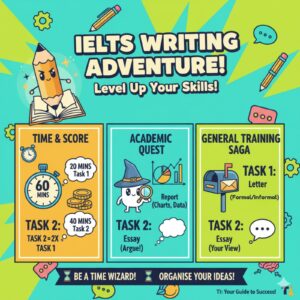
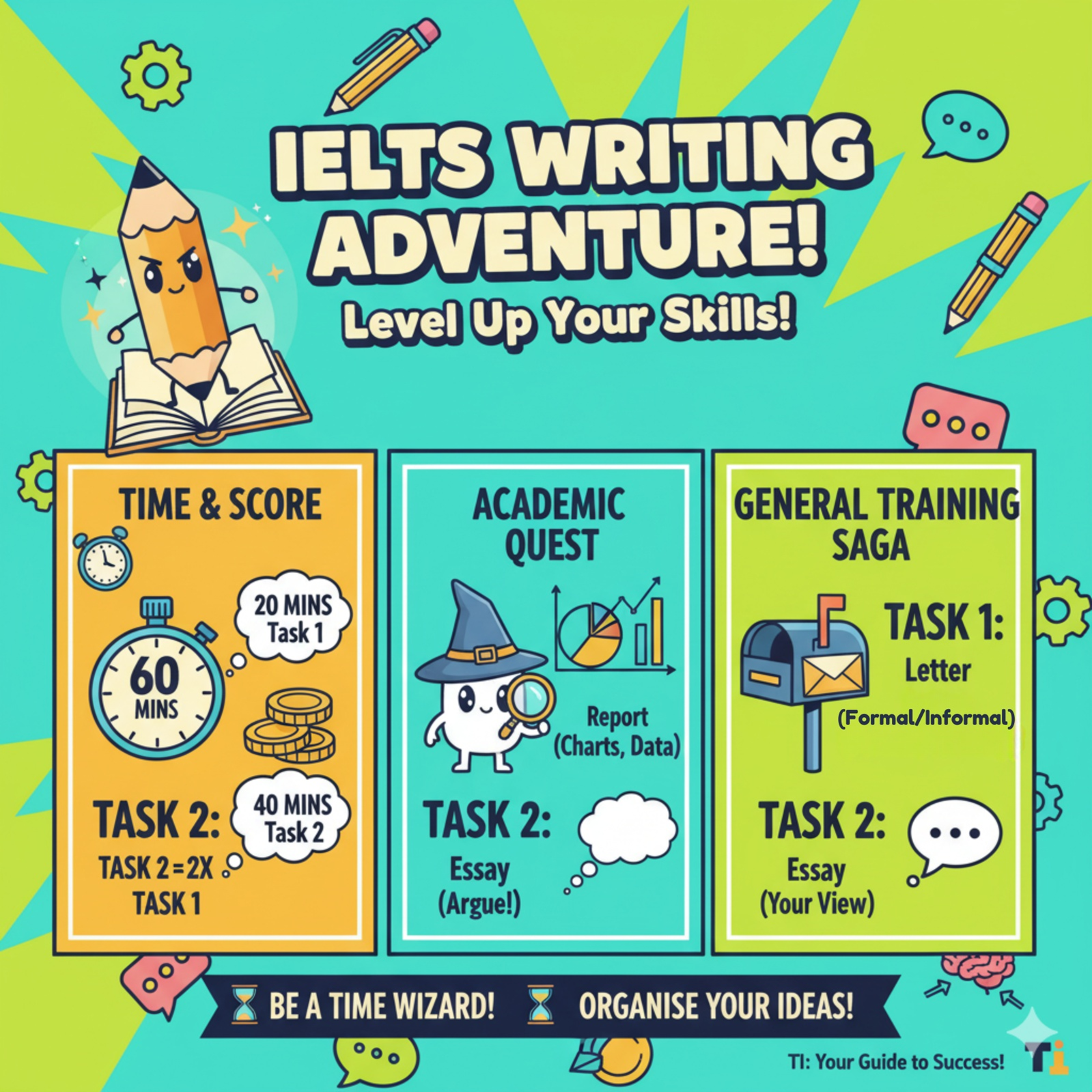
Time Taken: The IELTS Writing test takes one hour. One is advised to spend 20 minutes on Task 1, and 40 minutes on Task 2. The person who is writing the test needs to manage his/her own time, so one has to be sure to move to Task 2 after 20 minutes. Number of Tasks Given: The IELTS Writing Test module comprises of two tasks. One is asked to write minimum 150 words for Task 1 and minimum 250 words for Task 2. The content of the Writing Test for IELTS Academic is different from IELTS General Training tests.
In Academic Task 1 of the IELTS Writing module, one is expected to write a short descriptive report based on visual information or data which has been provided in the question. However, the heartening news is that, in this module, all the content that one needs to include in his/her answers are provided in the diagrams that are given to them. These could be anything from pie charts, bar charts, graphics, tables or any other pictorial representation of some data. Sometimes, it can be a mixture of two or three of these diagrams.
The person who is writing the test is not required to explain or interpret the data in front of him/her. However, it might involve describing the data or diagram, the stages of a process or how something works, or describing an object or an event. In Task 2, one is asked to write an essay in response to a point of view, argument or problem. Organising the paragraphs is also very important, because in many cases the examiner do not get into the details of the facts and figures given in the diagram or data, but rather concentrates on the description and depiction given by the student.
IELTS General Training Writing Test: The topics used in the IELTS General Training Writing test are of common interest. In Task 1, one is presented with a situation and asked to write a letter requesting information or explaining the situation. One can write the letter in a personal, semi-formal or formal style. In Task 2, the person is asked to write an essay in response to a point of view, argument or problem. One can use a fairly personal style here, asserting his/her own views.
Marking: The IELTS Writing test module will be marked by a certificated IELTS examiner. Task 2 is worth twice as much as Task 1 in the IELTS Writing test. Scores are reported in whole and half bands. The topics used in the IELTS General Training Writing test are of general interest. In Task 1 you will be presented with a situation and asked to write a letter requesting information or explaining the situation. You can write the letter in a personal, semi-formal or formal style. In Task 2 you will be asked to write an essay in response to a point of view, argument or problem. You can use a fairly personal style.
Whether it is training for IELTS General or Academic Writing module, TI gives the best guidance and mentoring for the course!